What Is Sudoku? The Puzzle That Conquered the World
An American inventor, a Japanese publisher, a retired judge, and nine little numbers. The unlikely story of how Sudoku became one of the world's favorite puzzles.
There are 81 squares, nine numbers, and just three rules. No complicated equipment, no mathematical genius required, and certainly no need to remember anything from high school algebra.
Yet somehow, this modest little grid has kept millions of people happily occupied for decades.
Sudoku is a logic-based number puzzle in which you fill a 9×9 grid so that every row, every column, and every 3×3 box contains the numbers 1 through 9 exactly once. Some numbers are already provided as clues. Your job is to work out the rest.
Simple? Absolutely. Easy? That depends on the puzzle.
What makes Sudoku particularly interesting is its history. Despite its Japanese name, the modern game was born in the United States, found its identity in Japan, and became an international sensation thanks to a newspaper in London.
Let's explore how it happened, what makes Sudoku so satisfying, and why a puzzle made from the same nine numbers still has a remarkable future.
Sudoku in 30 Seconds
If you've never played Sudoku before, here's everything you need to know.
| Question | Answer |
|---|---|
| What is Sudoku? | A number-placement logic puzzle |
| How big is the classic grid? | 9 rows × 9 columns, with 81 cells |
| What numbers are used? | The digits 1 through 9 |
| What is the objective? | Complete every row, column, and 3×3 box without repeating a digit |
| Do you need maths? | No calculations are required |
| Where was modern Sudoku invented? | The United States, in 1979 |
| Where did the name come from? | Japan |
| When did it become a worldwide hit? | Mainly during 2004 and 2005 |
| Can beginners learn it? | Absolutely |
You can play free Sudoku online at PlaySudoku.com whenever you're ready to put those rules into practice.
How Does Sudoku Work?
A traditional Sudoku board contains 81 cells arranged into nine rows, nine columns, and nine smaller boxes. Each box contains nine cells.
Some cells already contain numbers. These are called givens or clues, and they stay exactly where they are.
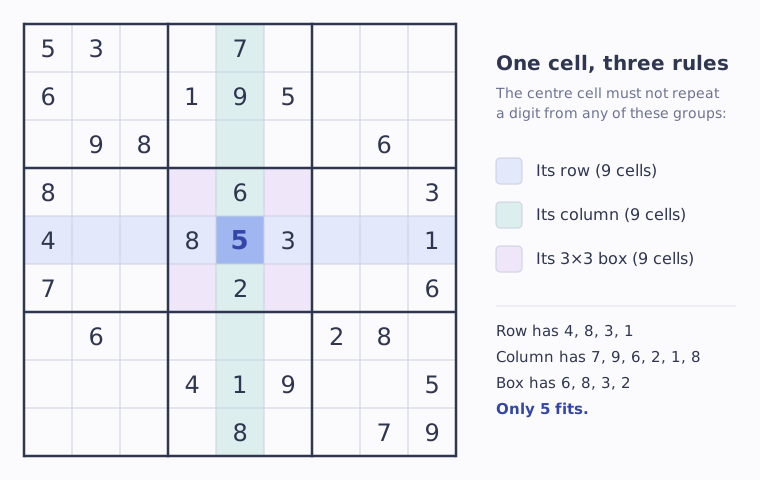
Your challenge is to fill the empty cells while obeying three rules:
- Every row must contain the numbers 1 through 9 exactly once.
- Every column must contain the numbers 1 through 9 exactly once.
- Every 3×3 box must contain the numbers 1 through 9 exactly once.
That's it. There is no fourth rule hiding in the small print.
A simple example
Imagine a row already contains:
1 - 2 - 3 - 4 - 5 - 6 - 7 - 8 - ?
The missing number must be 9.
Of course, real Sudoku puzzles are rarely that generous. Usually, you'll have to examine the row, column, and box together to identify a number's only possible position.
For example, if an empty cell could theoretically contain 3, 6, or 8, but its column already has a 3 and its box already has a 6, the answer must be 8.
That's logical deduction. And it's the foundation of the entire game.
A properly constructed classic Sudoku puzzle has exactly one complete solution. The challenge is to discover it, ideally through reasoning rather than trial and error.
Why numbers, if there is no maths?
Because numbers are convenient symbols that everyone recognizes.
You never have to add, multiply, or divide them. In fact, a standard Sudoku puzzle could use nine different letters, colors, or pictures instead of the digits 1 through 9.
The logic would work exactly the same way.
Think of Sudoku as a puzzle about where things belong, rather than what numbers mean.
Is Sudoku Japanese? Not Quite
Here's the first surprise.
Sudoku is usually described as a Japanese puzzle. That's understandable: the name is Japanese, and Japan played an enormous role in making the game what it is today.
But the modern Sudoku puzzle was first published in the United States in 1979, under the rather less memorable name Number Place.
And its mathematical family tree stretches back even further, to Europe.
So where did Sudoku really come from?
The answer involves several countries and several people who made very different contributions.
The History of Sudoku
1. The mathematical ancestors: Europe, centuries ago
Long before Sudoku appeared in puzzle magazines, mathematicians were interested in arranging symbols in grids according to strict rules.
One important predecessor is the Latin square.
In a Latin square, each symbol appears exactly once in every row and every column. The Swiss mathematician Leonhard Euler studied these arrangements in the 18th century.
You might recognize the similarity immediately.
A completed Sudoku is essentially a Latin square with an additional requirement: every 3×3 box must also contain each symbol exactly once.
But Euler did not invent modern Sudoku. He was studying mathematical arrangements, not creating the familiar newspaper puzzle.
During the late 19th century, French newspapers also experimented with number-placement games and magic squares.
In 1892, the French newspaper Le Siècle published a 9×9 number puzzle divided into smaller compartments.
Then, on July 6, 1895, La France published an even closer relative of modern Sudoku, using the digits 1 through 9.
These puzzles were fascinating early relatives, but their rules were not identical to modern Sudoku.
The distinction matters. A mathematical ancestor is not necessarily the inventor of the game we play today.
2. The American architect: Howard Garns, 1979
The modern story begins in Indiana, United States, with a retired architect named Howard Garns.
In 1979, the American publisher Dell introduced a puzzle called Number Place in its puzzle magazine.
It used the familiar modern Sudoku structure: a 9×9 grid, divided into 3×3 boxes, with some digits already filled in.
Garns is widely credited with creating it.
There's a delightful detective story behind that attribution.
The puzzles themselves did not carry the creator's name. Years later, puzzle historian and New York Times crossword editor Will Shortz investigated Dell's contributor lists.
He noticed that Garns was listed as a contributor in issues containing Number Place, but not in issues without it. Evidence from Garns's former colleagues further supported the attribution.
The case is persuasive, although the original magazine did not explicitly identify him as the puzzle's creator.
Garns died in 1989.
He never lived to see his puzzle become a worldwide phenomenon. The game that would eventually appear in newspapers, books, computers, and millions of pockets was still a relatively obscure magazine pastime.
Not bad for a retirement project, though.
3. Japan gives the puzzle its identity: 1984
The next important character is Maki Kaji, a Japanese publisher and founder of the puzzle company Nikoli.
Kaji came across Number Place in an American puzzle magazine and saw its potential.
In 1984, Nikoli introduced the game to Japanese readers with the rather lengthy title:
Sūji wa dokushin ni kagiru.
The phrase roughly means that numbers must remain single or unmarried.
Fortunately for newspaper editors everywhere, the name was eventually shortened to Sudoku.
- Su refers to a number.
- Doku means single.
The Japanese name stuck.
Kaji did more than rename the game. Nikoli helped develop the puzzle's presentation and construction style.
In 1986, the company adopted symmetrical arrangements of starting clues as a house rule. This created the elegant visual patterns that still appear in many printed Sudoku puzzles.
Symmetry is not required by Sudoku's logic. It simply makes a puzzle look more carefully composed.
Nikoli also placed great importance on handcrafted puzzles and the enjoyment of the solving process.
To Kaji, a good logic puzzle was not just an arrangement of numbers. It was a small piece of entertainment, designed to surprise and satisfy the person solving it.
A wonderful piece of trivia: Nikoli itself was named after a racehorse that competed in the 1980 Epsom Derby. So a puzzle that would eventually travel the world owes part of its identity to horse racing.
Kaji later became known internationally as the "Godfather of Sudoku." He died in 2021, having seen the puzzle spread far beyond Japan.
4. The retired judge who brought Sudoku to the world: 1997-2005
Enter Wayne Gould, a retired judge from New Zealand who had worked in Hong Kong.
In 1997, Gould discovered Sudoku while visiting a bookstore in Tokyo.
He became fascinated by it.
Rather than simply solving the puzzles, he spent years developing a computer program capable of generating new Sudoku grids and assessing their difficulty.
That technical achievement was important.
Newspapers needed a reliable supply of fresh puzzles. A program capable of producing and grading them made large-scale publication much easier.
In November 2004, Gould persuaded The Times in London to publish Sudoku.
The newspaper's own historical records confirm that its first Su Doku puzzle appeared on November 12, 2004.
The timing was extraordinary.
Within months, competing British newspapers were publishing their own Sudoku puzzles. Readers who had never heard the name became enthusiastic solvers. Puzzle books appeared everywhere.
By 2005, Sudoku had become an international sensation.
Gould hadn't invented the puzzle, and Kaji hadn't invented its underlying rules. But together with Garns and the publishers who embraced the game, they helped turn a relatively obscure concept into a global pastime.
Sometimes an idea needs several people, several countries, and just the right moment to take off.
Sudoku certainly did.
Sudoku Timeline
Here's the remarkable journey at a glance.
| Year | Milestone |
|---|---|
| 18th century | Leonhard Euler's work on Latin squares establishes an important mathematical connection |
| 1892 | The French newspaper Le Siècle publishes an early 9×9 number puzzle |
| 1895 | La France publishes a strikingly Sudoku-like number puzzle |
| 1979 | Dell publishes Number Place, widely attributed to Howard Garns |
| 1984 | Nikoli introduces the puzzle to Japanese readers |
| 1986 | Nikoli adopts symmetrical starting-clue patterns as a construction convention |
| 1997 | Wayne Gould discovers Sudoku in a Tokyo bookstore |
| 2004 | The Times begins publishing Sudoku on November 12 |
| 2005 | The Sudoku craze spreads rapidly through newspapers and puzzle books worldwide |
| 2006 | The first World Sudoku Championship takes place in Lucca, Italy |
| 2012 | Researchers announce a proof that a standard Sudoku needs at least 17 clues for a unique solution |
| 2014 | The 17-clue proof appears in the journal Experimental Mathematics |
| 2020s | Sudoku continues to thrive across newspapers, websites, mobile apps, and competitive puzzle communities |
How Sudoku Took Over the World
The Sudoku boom wasn't driven by a Hollywood movie, a television series, or a celebrity endorsement.
It was driven by a newspaper puzzle that people could understand almost immediately.
That simplicity made Sudoku unusually easy to spread.
A puzzle that doesn't need translating
Crosswords depend heavily on language. A crossword written for British readers might be almost impossible for someone who doesn't speak English.
Sudoku is different.
A 7 is a 7 whether you're in Tokyo, Brussels, New York, or Buenos Aires.
The rules can be explained in a few sentences, and the puzzle itself works across languages and cultures.
That makes Sudoku a remarkably portable form of entertainment.
The perfect newspaper companion
Sudoku arrived at a moment when printed newspapers still played an important role in people's daily routines.
A puzzle could be completed with nothing more than a pencil and a few quiet minutes.
It was easy to carry, easy to share, and difficult enough to be satisfying.
The familiar newspaper routine soon developed: coffee, headlines, Sudoku. Possibly another coffee if the Sudoku wasn't cooperating.
Then came the digital revolution
As games moved to computers, smartphones, and tablets, Sudoku adapted naturally.
Online versions could generate new puzzles instantly. Players no longer needed an eraser, and mistakes could be undone with a click.
Digital games also made it easier to offer difficulty levels, notes, hints, saved progress, and daily challenges.
The basic idea stayed exactly the same. Only the paper disappeared.
Sudoku becomes a competitive sport
Yes, competitive Sudoku really exists.
The first World Sudoku Championship took place in Lucca, Italy, in March 2006, organized with the World Puzzle Federation.
Its first individual champion was Jana Tylová of the Czech Republic.
Competitors solve demanding puzzles against the clock, often including creative variants that require additional rules.
Most of us are perfectly happy completing a puzzle before lunch. World-class competitors operate on an entirely different level.
Sudoku by the Numbers
Sudoku uses only nine digits, but its mathematics is anything but small.
Here are some remarkable facts.
1. There are over 6 sextillion completed Sudoku grids
Mathematicians Bertram Felgenhauer and Frazer Jarvis calculated that the number of valid completed classic 9×9 Sudoku grids is:
6,670,903,752,021,072,936,960
That's approximately 6.67 sextillion.
And to be precise, this counts completed grids satisfying the Sudoku rules, not the total number of distinct playable puzzles.
A single completed grid can produce many different starting puzzles, depending on which numbers are removed.
So don't worry about running out of Sudoku anytime soon.
2. Some grids are essentially copies of others
Suppose you take a completed Sudoku and replace every 1 with a 9 and every 9 with a 1.
The grid looks different, but its logical structure hasn't fundamentally changed.
You can also rotate grids, reflect them, and rearrange certain rows or columns while preserving the rules.
When mathematicians account for these equivalences, the number of essentially different completed Sudoku grids becomes:
5,472,730,538
That's still more than 5.4 billion fundamentally different grids.
If you examined one every second without stopping, it would take approximately 173 years.
You might want to pack a lunch.
3. Seventeen is a magic number
What's the smallest number of starting clues a classic Sudoku puzzle can have while still having exactly one solution?
The answer is 17.
For years, mathematicians knew that 17-clue puzzles existed, but they couldn't prove that a valid puzzle with only 16 clues was impossible.
In 2012, Gary McGuire, Bastian Tugemann, and Gilles Civario announced the result of an exhaustive computational search.
Their work established that no standard 16-clue Sudoku has a unique solution.
The research was subsequently published in Experimental Mathematics in 2014.
One important detail: a puzzle with only 17 clues isn't automatically the hardest. Difficulty depends more on the deductions needed than on the sheer number of clues.
4. Sudoku has no universal difficulty scale
One website's "Hard" Sudoku might be another website's "Medium."
There is no single difficulty standard used by every publisher.
Some rating systems analyze the logical techniques needed to solve a puzzle. Others use computational measures or different grading methods.
That's why two puzzles with similar numbers of clues can feel completely different.
A thoughtfully designed puzzle can be easy to understand but wonderfully challenging to solve.
The Many Types of Sudoku
Classic Sudoku is just the beginning.
Puzzle creators have developed many variations, from beginner-friendly grids to challenges that require seriously advanced reasoning.
| Type | What makes it different? |
|---|---|
| Classic Sudoku | The familiar 9×9 grid with nine 3×3 boxes |
| Mini Sudoku | Smaller grids, often 4×4 or 6×6, suitable for beginners |
| 12×12 Sudoku | A larger grid using 12 distinct symbols and appropriately sized boxes |
| 16×16 Sudoku | A much larger grid with 256 cells and 4×4 boxes |
| Killer Sudoku | Adds cages with required sums, combining logic with arithmetic |
| Diagonal Sudoku | Both main diagonals must also contain each digit exactly once |
| Samurai Sudoku | Typically combines five overlapping 9×9 grids |
| Jigsaw Sudoku | Replaces regular 3×3 boxes with irregular nine-cell regions |
| Thermo Sudoku | Numbers must increase along thermometer-shaped lines |
Some variants change the size of the grid. Others add entirely new constraints.
Killer Sudoku is an especially interesting exception to the usual claim that Sudoku requires no maths, because its cage sums involve arithmetic.
The beauty of the original game is that none of these variations is necessary to enjoy it.
You can spend years playing classic 9×9 Sudoku and still discover new solving techniques.
Why Is Sudoku So Popular?
There isn't one magical explanation, but a few qualities help explain its lasting appeal.
The rules are simple, but the challenge keeps growing
Most people can learn the basic rules in a minute or two.
Actually becoming good at Sudoku takes longer.
As players improve, they discover patterns, techniques, and increasingly subtle deductions. The game grows with them.
It creates satisfying little victories
Sudoku has a special rhythm.
You study a grid. Nothing seems obvious. You look again. Suddenly, one number becomes certain.
That number reveals another possibility. Then another.
A complicated puzzle begins to unravel.
It's a small but wonderfully satisfying experience, especially when you've been staring at the same stubborn box for five minutes.
It offers a quiet moment
Not everyone wants an online game filled with sound effects, animations, notifications, and a fictional kingdom that desperately needs rebuilding.
Sometimes you just want a puzzle.
Sudoku offers an absorbing activity that can be enjoyed at your own pace.
No opponent. No storyline to remember. No complicated instructions.
Just a puzzle and the satisfaction of figuring it out.
You can make it your own
Some players race against the clock. Others deliberately ignore the timer.
Some love difficult puzzles. Others prefer the pleasant rhythm of easier grids.
There are people who carefully write every candidate number, and people who solve almost entirely in their heads.
Sudoku accommodates all of them.
And that flexibility is a big part of its appeal.
Is Sudoku Good for Your Brain?
Sudoku involves attention, working memory, pattern recognition, and logical reasoning.
Solving a puzzle gives you practice using those abilities within the game.
But there's an important distinction between enjoying a mentally engaging activity and proving that it prevents cognitive decline or dementia.
Scientific research has not established that regularly playing Sudoku prevents Alzheimer's disease or guarantees broader improvements in intelligence or memory.
Some studies find associations between puzzle activities and cognitive performance, but an association does not prove that the puzzles caused the difference.
Researchers also emphasize the value of varied, challenging activities rather than relying on one familiar exercise.
So the best reason to play Sudoku is refreshingly straightforward:
It's enjoyable, mentally engaging, and gives you a satisfying challenge.
If you become excellent at Sudoku, that's an achievement in its own right. You don't need to claim a higher IQ to justify enjoying it.
How to Get Better at Sudoku
Want to improve your solving skills? Start with a few habits that make a real difference.
1. Begin with singles
A naked single occurs when a cell has only one possible number.
A hidden single occurs when a number can go in only one cell within a particular row, column, or box.
These are the foundations of Sudoku solving.
2. Look for opportunities across the whole grid
It's tempting to concentrate on one particularly difficult section.
But sometimes the most useful move is somewhere else.
Scan the grid regularly. A number placed in one corner may unlock a deduction on the other side.
3. Use pencil marks when necessary
Pencil marks, also called candidates, are small notes recording the numbers that might fit in an empty cell.
They're particularly helpful once a puzzle requires you to compare several possibilities.
Just remember that a candidate is a possibility, not a confirmed answer.
4. Learn a new technique when you're ready
After mastering singles, explore:
- Locked Candidates
- Naked Pairs
- Hidden Pairs
- X-Wing
- XY-Wing
You don't need to learn everything at once.
One new technique can make puzzles that once felt impossible suddenly manageable.
5. Enjoy the solution, not just the stopwatch
Speed is fun, but it isn't the only measure of skill.
A careful, fully logical solve can be more rewarding than finishing quickly through trial and error.
And sometimes the best move is simply to put the puzzle aside for a few minutes and return with fresh eyes.
The Future of Sudoku
Sudoku has already made an extraordinary journey.
It moved from a printed American puzzle to a Japanese magazine, from British newspapers to international bestseller lists, and eventually onto millions of digital screens.
So what's next?
Better digital experiences
Modern websites can make Sudoku smoother and more accessible with features such as automatic saving, adaptable interfaces, keyboard controls, pencil marks, and different levels of assistance.
The challenge is to introduce useful technology without making a simple game unnecessarily complicated.
The best online Sudoku should still feel like Sudoku.
Smarter, more helpful hints
Traditional hints often reveal a number without explaining why it belongs there.
More advanced solving tools can identify a logical deduction, explain the underlying technique, and help the player understand the next step.
That opens an interesting possibility: Sudoku websites can become places where people learn to solve better, not merely places where they complete puzzles.
Artificial intelligence and puzzle creation
Computers have been generating and solving Sudoku puzzles for decades, well before today's generative AI systems.
Modern algorithms can produce enormous numbers of valid grids, verify unique solutions, and analyze solving techniques.
AI may help with personalized instruction, puzzle recommendations, and more accessible explanations.
But there is still something special about a puzzle deliberately constructed by a human setter.
A beautifully designed Sudoku can guide the solver through a sequence of discoveries. It can have surprises, elegance, and a satisfying finish.
The best future may combine reliable computation with human creativity.
A worldwide community of solvers
Online communities allow players to share unusual puzzles, discuss techniques, compare solutions, and learn from experienced constructors.
There's room for beginners who simply want a pleasant daily puzzle and enthusiasts who love sophisticated logical deductions.
That's one of Sudoku's strengths: a single set of basic rules can support an enormous range of experiences.
Some things won't change
Technology will evolve. New variants will appear. Solving tools will become more sophisticated.
But a classic Sudoku will still be recognizable a hundred years from now.
Nine rows. Nine columns. Nine boxes. Nine numbers.
And that wonderful moment when the next number finally clicks.
Frequently Asked Questions
Who invented Sudoku?
The modern Sudoku puzzle is widely credited to Howard Garns, an American architect whose Number Place puzzle appeared in a Dell magazine in 1979. Earlier mathematical puzzles influenced its development, but Garns is generally recognized as the creator of the modern format.
Is Sudoku Chinese or Japanese?
Modern Sudoku originated in the United States. Its name and important refinements came from Japan, where Nikoli introduced the puzzle in 1984. Earlier number-placement and mathematical ideas existed in several countries.
What does Sudoku mean in Japanese?
Sudoku is a shortened form of a Japanese phrase roughly meaning that numbers must remain single. The name refers to the rule that each number must appear only once in every row, column, and box.
When did Sudoku become popular worldwide?
Sudoku's international breakthrough took place mainly in 2004 and 2005. A key moment was November 12, 2004, when The Times in London began publishing the puzzle.
Is Sudoku a maths game?
Classic Sudoku uses numbers, but it does not require calculations. It is fundamentally a logic and pattern-recognition puzzle. Some variants, including Killer Sudoku, do involve arithmetic.
How many different Sudoku puzzles are possible?
There are exactly 6,670,903,752,021,072,936,960 valid completed classic Sudoku grids. The number of possible playable puzzles is much larger because different sets of starting clues can lead to the same completed grid.
What is the hardest Sudoku?
There is no universally accepted hardest Sudoku puzzle. Difficulty depends on the logical techniques needed and on the rating system being used. Having fewer starting numbers does not automatically make a puzzle more difficult.
Can every Sudoku puzzle be solved without guessing?
A properly constructed classic Sudoku puzzle has one solution. In principle, that solution can be established through logical reasoning, although some especially difficult puzzles require much more sophisticated deductions than the basic techniques beginners use.
Can children play Sudoku?
Yes. Smaller Sudoku grids, such as 4×4 or 6×6 puzzles, are often good introductions for children. They use the same basic no-repetition principle while requiring fewer numbers.
Where can I play Sudoku online for free?
You can play free Sudoku puzzles at PlaySudoku.com directly in your browser. Start with a comfortable difficulty and enjoy solving at your own pace.
One Last Number
For a game that uses only nine digits, Sudoku has had a surprisingly adventurous life.
An American architect created the modern puzzle. A Japanese publisher gave it a name and a distinctive identity. A retired judge helped bring it into newspapers. Mathematicians discovered astonishing things about its possibilities. And millions of players found pleasure in its simple rules.
That's quite a journey for 81 little squares.
And the best part?
You don't need to know any of that history to enjoy your next puzzle.
Ready to play? Start a free Sudoku at PlaySudoku.com.
Sources and Further Reading
The historical dates, mathematics, and scientific claims in this article are supported by the following sources:
- Nikoli - Sudoku: Rules, History and Popularity - The Japanese publisher's first-hand account of the game's introduction and naming.
- Oxford University Press - History of Sudoku - Academic treatment of the origins and Howard Garns attribution.
- The Guardian - Maki Kaji Obituary - Historical reporting on Nikoli, the game's popularity, and the role of puzzle construction.
- News UK - History of The Times - Confirmation of the November 12, 2004 publication date.
- TIME - Wayne Gould, The TIME 100 (2006) - Will Shortz's account of Sudoku's international expansion.
- Guinness World Records - First Sudoku World Championship - Location, date, and first champion.
- Frazer Jarvis - Sudoku Enumeration Problems - Original mathematical counting results.
- McGuire, Tugemann and Civario - There Is No 16-Clue Sudoku - Published mathematical proof of the minimum number of clues.
- UW Medicine - Can Sudoku and Crosswords Improve Your Brain Health? - Evidence-based discussion of cognitive-health claims.